With the shift from spring to autumn Budgets, it’s easy to overlook some key tax and other related changes that will take effect from 6 April for the 2026/27 tax year. Many of these have been in the pipeline for some time so may have slipped your attention since they were first announced. Here is a quick reminder of some of the measures that may affect you over the coming tax year and beyond.
Making Tax Digital (MTD) for income tax
From 6 April 2026, MTD for income tax begins to operate for the self-employed and landlords with 2024/25 qualifying income (roughly equating to gross income from both sources) of over £50,000. Under MTD, quarterly returns of income and expenses must be submitted to HMRC using approved software, with the first report due by 7 August 2026. For 2027/28, the qualifying income threshold will drop to £30,000 in 2025/26.
Dividend tax rates
From 2026/27, the rate of tax on dividends will increase by two percentage points for dividends falling in the UK basic rate band (i.e. from 8.75% to 10.75%). For dividends falling in the UK higher rate band, the increase will be from 33.75% to 35.75%. Dividends falling in the additional rate band and the dividend trust rate will be unchanged at 39.35%.
Tax on interest and other savings income
From 2027/28, all savings tax rates on interest will increase by two percentage points, taking the maximum rate to 47% for additional rate taxpayers and most trusts.
Venture capital trusts (VCTs)
From 6 April 2026, the rate of income tax relief for investments in newly issued VCT shares will drop from 30% to 20%. At the same time the size of companies covered by the scheme will broadly double. The rate of tax relief for Enterprise Investment Scheme (EIS) investments remains at 30%., despite the VCT cut.
Capital gains tax (CGT)
For 2026/27 onwards, the rate of capital gains tax on disposals qualifying for business assets disposal relief will rise from 14% to 18%. Other rates of CGT remain unchanged, as does the annual exemption at £3,000.
Inheritance tax (IHT) business and agricultural relief
New rules for agricultural and business IHT reliefs come into effect from 6 April 2026. These have altered significantly from the proposals in the Autumn 2024 Budget. The 100% relief allowance will be a combined £2,500,000, with 50% relief applying thereafter. Any unused 100% allowance will be transferable between surviving spouses and civil partners. AIM shares will only be entitled to 50% business relief.
IHT and pensions
From 2027/28, most pension death benefits (other than death-in-service benefits) will fall within the scope of IHT, adding both to the tax payable and the complexity of estate administration.
State pension age
From 6 April 2026, the phasing in of a new state pension age (SPA) of 67 will begin. For men and women born between 6 April 1960 and 5 March 1961, the state pension age will increase to between 66 years 1 month and 66 years 11 months. For those born on or after 6 March 1961, the state pension age will be at least 67. An announcement is due soon on the timing of the next SPA increase to 68, currently legislated for 2044-2046.
Student loan repayments
The repayment threshold for Plan 2 student loans (covering English and Welsh students who started their courses in academic years 2012/13 to 2022/23) will rise by 3.2% to £29,385 for 2026/27 and then be frozen for the following three years for English graduates and students. The threshold for Plan 2 loans to Welsh students will not be frozen.
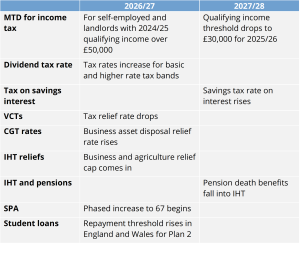
Key tax changes at a glance
 If you believe you may be affected by any of these measures, please get in touch to discuss your situation.